
Accepting cards costs you money on every card sale. Dual pricing posts two prices, one for cash and one for card, so that cost sits in the posted price instead of coming out of your margin. The customer sees both before they choose, and the terminal charges the one that matches how they paid.
Apply onlineDual pricing is simple: your business displays two prices upfront, one for cash and one for card. The customer sees pricing before they pay, chooses their payment method, and the system applies the correct total automatically. The result is a straightforward checkout experience and better protection for your margins on credit transactions.
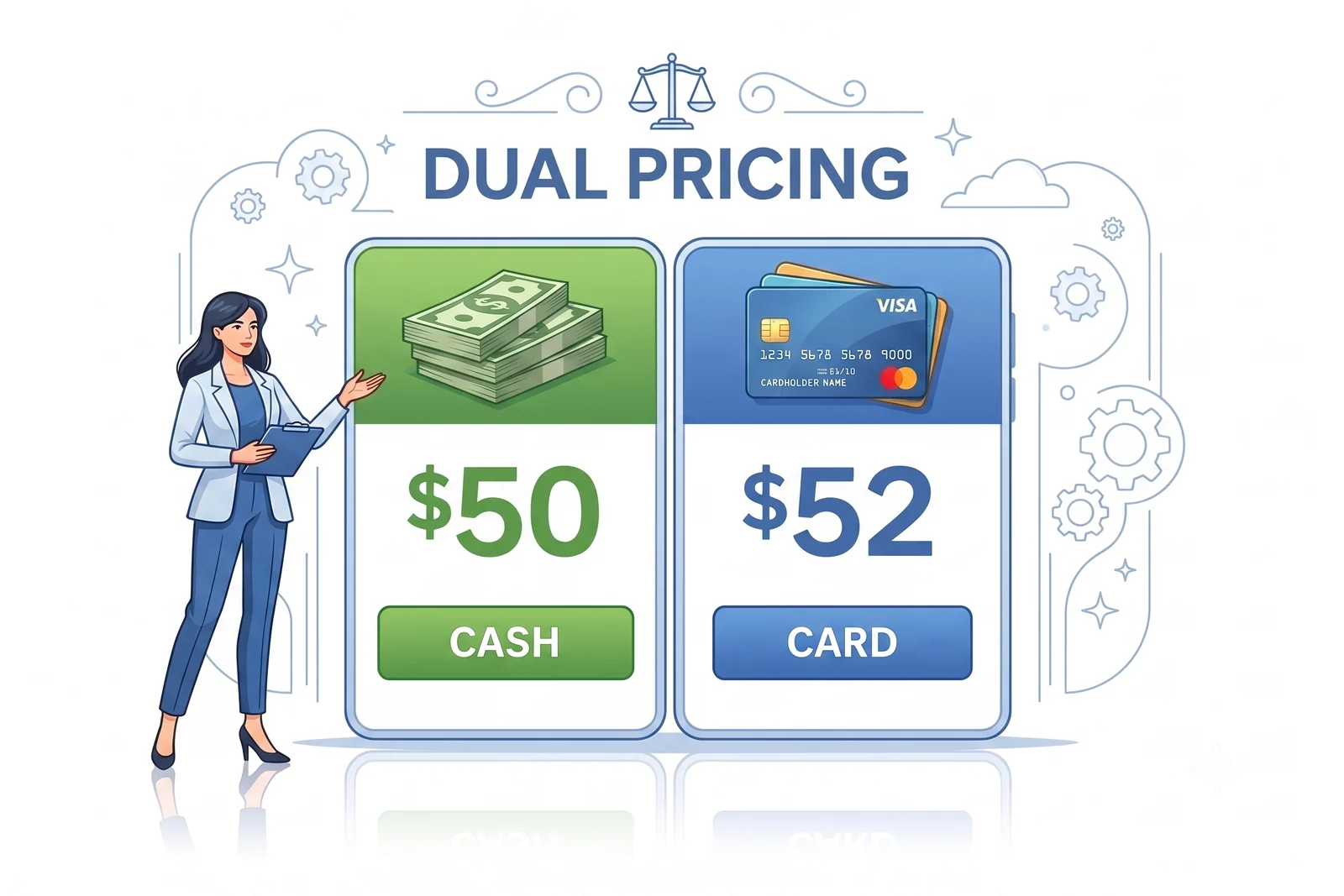
Your menu, invoice, or checkout display clearly shows a cash price and a card price.
Customers pick the option that works best for them. Nothing is added at the end of the sale.
The payment flow recognizes the method and completes the sale with the right posted price.
Our standard program posts a card price 4 percent above the cash price. That 4 percent is set to cover the cost of accepting cards, so the cost sits in the posted price rather than coming out of your margin.
Arithmetic on round numbers, not a quote. Four percent is our standard and it can be set lower, in which case part of the cost of processing stays with you. What you actually keep depends on your card mix, your ticket size, and the rate you are on today, which is why we work from a recent statement rather than from a table.
Nothing is added at checkout. Both prices are posted before the customer decides how to pay, and the one that matches their choice is the one they are charged. There is no separate line on the receipt because there is no extra line to add.
That is the other methods of passing card costs along. Adding a percentage to a card sale at the register is limited by state law and by card brand rules. Dual pricing is posted pricing, and it works in all fifty states. Even the states that regulate the other approaches most tightly require both prices to be displayed, which is exactly what dual pricing does by design.
They do not. Debit is a card. Credit and debit are both charged the posted card price.
Raising your prices charges everyone the same, whether they cost you more to serve or not. Dual pricing leaves your cash price where it is and puts the cost of card acceptance on the sales that create it.
My customers will be annoyed.
The merchants we have running it report very few pushbacks. The friction usually comes from a charge appearing at the end of a sale, when the customer feels caught out. Posted pricing removes that moment, because both numbers are visible before anyone decides how to pay.
My staff will be explaining it all day.
Both prices are on the menu, the shelf, or the estimate, so most of the explaining happens before anyone reaches the counter. Depending on the device and the app you run, your team either selects the tender at checkout or the terminal handles it.
What if I want out later?
It is a paperwork change. No equipment swap, no re-application, and nothing about your counter has to change.
Four percent sounds like a lot.
It is set to cover what card acceptance costs, not to add margin. It can be set lower, and some merchants do that, which means part of the processing cost stays with you.
Dual pricing works best when it’s implemented consistently: clear price displays, smooth checkout behavior, and the right guidance for staff. EmeraldPay helps you launch with a setup that customers understand and your team can run confidently.

Get the program live the right way.
Smooth checkout your staff can trust.
Help when you need it, upgrades when you want them.
Yes. A check is charged the posted cash price, at the counter and over the phone.
Card sales away from the counter need an alternative tender available, and that is normally a check at the cash price. Tell us how much of your volume is not face to face when you apply and we will set it up around that.
No. There is no added line item. The customer is charged the posted price that matches how they paid, and that is the number on the receipt.
No. Dual pricing is a configuration on the equipment you are running. What differs between setups is whether your team selects the tender at checkout or the terminal does it.
Yes. Four percent is our standard because it is set to cover what card acceptance costs. Setting it lower means part of that cost stays with you.
A paperwork change. No equipment swap and no re-application.
Clear posted pricing, customer choice, and a checkout experience that stays simple.